


Slit Lamp Repair: Common Problems & When to Call a Tech
Your slit lamp is the workhorse of the exam lane. When the illumination starts to flicker or the optics won't snap into focus, the whole schedule backs up behind it. If you're reading this, you've probably already tapped the bulb housing, nudged the joystick, and hoped it was a one-time thing.
Here's the good news: most slit lamp problems are fixable, and a repair almost always costs less than a replacement. The hard part is knowing what you're looking at and when to hand it to a technician. This guide walks through the most common slit lamp problems, what a repair involves, and how to decide between fixing it and replacing it.
What a Slit Lamp Does, and Why Precision Matters
A slit lamp pairs a binocular microscope with an adjustable beam of light. You use it to examine the cornea, lens, iris, and anterior chamber at high magnification. The instrument only earns its keep when the light, the optics, and the mechanics all stay in alignment.
When any one of those drifts, your view degrades in ways that are easy to misread as a patient issue instead of an equipment issue. A dim beam or a hazy field can hide a finding you needed to catch. That's why a slit lamp that isn't performing isn't a minor annoyance. It's a clinical tool that's no longer telling you the truth.
Six Common Slit Lamp Problems
After decades on the bench, the same handful of complaints come up again and again. Here are the ones we see most.
Illumination and bulb issues
Flickering, dimming, or a beam that won't come on at all usually points to the bulb, the bulb socket, or the wiring to it. Bulbs are consumables and they fade over time, so a gradual loss of brightness is often just a bulb at the end of its life. If a fresh bulb doesn't fix it, the socket contacts or the rheostat that controls intensity may be the real culprit.
Focus and optical clarity
A field that won't sharpen, double images, or a smudgy haze you can't clean away often means the optics are out of alignment or there's debris or fungus inside the prisms. Internal contamination is more common in humid climates and in instruments that sit unused for long stretches. This is not a DIY cleaning job. Opening the optical path without the right tools usually makes things worse.
Then there are the mechanical complaints: a magnification drum that sticks between settings, a joystick that drifts so the image won't hold still, and base movement that feels gritty or loose. Each of these is a wear pattern, not a mystery, and each has a standard fix.
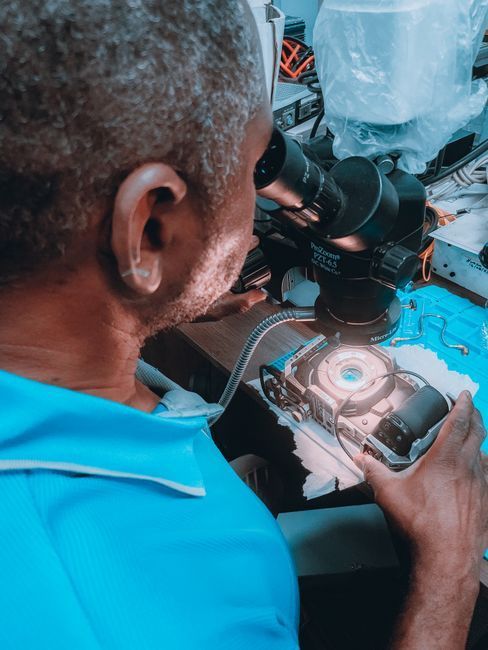
From the Bench: Before you call anything broken, swap the bulb and check that the instrument is getting steady power. A loose plug or a tired bulb mimics half the "serious" failures we get calls about, and it's a two-minute check that can save you a service visit.
Repair or Replace? How to Decide
A slit lamp is built to last for decades, so age alone rarely justifies replacing one. The better questions are: how much will the repair cost against the value of the instrument, and how reliable has it been lately?
If a well-built slit lamp needs a bulb, a joystick rebuild, or an optical realignment, repair is almost always the smart call. If the frame is damaged, parts are no longer available, or you're sending it out every few months, that's when replacement or a quality reconditioned unit starts to make sense. Capital Ophthalmic has spent more than 45 years doing one thing well across the Southeast: keeping ophthalmic instruments accurate and in service. That focus is why practices call us before they spend on a brand-new lamp they may not need. If a replacement does turn out to be the move, our reconditioned ophthalmic equipment is inspected, calibrated, and backed by a performance guarantee.
What Professional Slit Lamp Repair Involves
A proper repair starts with diagnosis, not guesswork. A technician powers up the instrument, reproduces the complaint, and traces it to the actual cause instead of replacing parts at random. From there the work might include bulb and socket service, cleaning and realigning the optics, rebuilding the joystick and base mechanics, and a final calibration check so magnification and illumination read true.
The last step matters as much as the first. An instrument that powers on but isn't calibrated can still give you a misleading view. You can see the full scope of what our team handles on the ophthalmic instrument repairs page.
How to Keep Your Slit Lamp Out of the Repair Shop
Most failures we see were preventable. Keep the optics capped when the instrument isn't in use, wipe down surfaces with the right cloth instead of paper towels, and keep liquids away from the base. In humid offices, a little climate control goes a long way toward keeping fungus out of the prisms.
The single best habit is an annual service check. A yearly once-over catches a fading bulb or a loosening joystick before it strands you mid-clinic. Our preventive maintenance program is built for exactly that, and you can compare instruments and brands in our ophthalmic equipment guide.
Worth Knowing: A slit lamp doesn't usually fail all at once. It degrades quietly, and your eyes adjust to the dimmer beam without realizing it. That's why a finding you'd normally catch in a second can slip past on a lamp that's been slowly fading for months.
Don't Lose Sight of a Fixable Problem
A flickering beam or a sticky joystick is rarely the end of a good slit lamp. Catch it early, get a real diagnosis, and you'll usually be back in the lane for a fraction of replacement cost. When your slit lamp starts acting up, reach out to our team for a repair quote before you write it off.
FAQs
What's the best way to handle slit lamp repair without losing days of patient care?
The best slit lamp repair approach is to catch problems early and ask whether a loaner is available while yours is serviced. A factory-trained technician can often diagnose the issue fast, and many repairs turn around quickly. Annual maintenance is what keeps small problems from becoming emergency downtime.
How long should a slit lamp last before it needs major work?
A quality slit lamp can serve a practice for 20 years or more with routine care. Bulbs and minor mechanical parts wear out along the way, but the core instrument rarely needs major work if it's maintained. Humidity, heavy daily use, and skipped servicing are the factors that shorten that lifespan.